THE WORD FOR THE BLOG IS SCIENTIFICTION

sábado, 2 de mayo de 2026

The Many by Sylvain Neuvel

Whoever tells you that science fiction has nothing new to offer, tell them about this novel.

What follows is not really a spoiler if you have already read the book’s synopsis: 

What Sylvain Neuvel offers in The Many has already been dealt with before, of course; at the end of the day, the science fiction genre as such already has more than a century of history; but in this novel the author provides a very innovative point of view. I think of major contributions from earlier novels and short stories such as Who Goes There? by John W. Campbell, or the masterful inversion of this story made by Peter Watts in The Things (it is actually based on the movie The Thing, itself based on John W. Campbell's novella); and also, of course, The Body Snatchers by Jack Finney.

As I say, here the author—as is already becoming something of a hallmark of his novels—achieves a very original way of expressing it. How? Well… although he has previously set up a solid worldbuilding, his best asset is his literary style: the very particular way he has of playing with the first-person narrator, even though he also combines it with the omniscient narrator.

After some opening chapters that are masterful in terms of the treatment of the characters, the narrative develops into territory that some readers may find more debatable, but that is not my case.

I do not want to explain more, only that in one sentence The Many could be described as the definitive ensemble novel.

sábado, 1 de febrero de 2025

Manual para pensar como un ingeniero aeroespacial de Sergio Hidalgo

Como siempre digo, un trabajo de divulgación que cumple con mis expectativas solo puede recibir una buena valoración.

Al parecer, este libro ha sido autoeditado por el propio Sergio Hidalgo. En este sentido, tanto el estilo como la corrección están dentro de lo razonable, e incluso un poco por encima.

En cuanto al contenido, que es lo que realmente me interesa, este libro satisface con creces mi curiosidad sobre el tema. Las explicaciones son suficientemente claras y el estilo resulta muy ameno. Cabe destacar que incluye fórmulas básicas (aerodinámica, resistencia, dinámica de flujos de un motor a reacción, etc.), así como enlaces a vídeos divulgativos, ya sea del propio autor o de terceros. En mi caso, no me he detenido ni en unas ni en otros, pues me basta con asimilar los conceptos expuestos.

Como alguien sin formación en física pero con interés en la materia, agradezco libros como este, que demuestran que es posible explicar conceptos complejos de cualquier tema de manera accesible.

Para interesados en el tema, recomiendo el canal del propio autor en Youtube. Y también otro buen libro sobre el tema que en su momento reseñé en este mismo blog (en inglés).

jueves, 16 de enero de 2025

El poema de la rosa als llavis Joan Salvat-Papasseit

Bé, no sé a quants parsecs de distància estic de la meva zona de confort pero aquí estem. Tot és començar, clar. Pràcticament des quan estudiava (excepte un intent de fa temps amb el Martí i Pol) que no llegia poesia. Em ve de gust fer-ho per què ara ningú m’obliga, clar. 


Ha estat una lectura enriquidora. Fins a cert punt m'ha colpit i m'ha transmès… coses: sentiments, apreciació estètica... D'això va la poesia, oi? 

Les dificultats que m'he trobat són, a part del medi “aliè” a les meves lectures habituals, trobo que la distància en el temps dificulta la lectura, més que pels costums (aquests els pot aprehendre si coneixes el context de l'època) i però sí que pel llenguatge; o sigui, el català literari de principis de segle XX. Cal dir que en la relectura tot ha estat un xic més fàcil.

D'altra banda, els versos tracten més del desig i l'erotisme que de l'amor, com em pensava al principi. Entre d’altres coses, clar, es poden entreveure uns quants temes més. Tots amb la manera sublim d'expressar-ho de Salvat-Papasseit. 


Vull seguir llegint poesia, alguna recomanació actual i accessible? 


sábado, 11 de enero de 2025

Deep Dream: Science Fiction Exploring the Future of Art (Twelve Tomorrows series), edited by Indrapramit Das

What a great discovery, this Twelve Tomorrows series! I hesitated to buy the eBook because I found it excessively expensive. In the end, I decided to go for it because I was very interested in the subject (to be fair, I must confess I’m interested in ALL science fiction topics and subgenres). In any case, I can say that the purchase was worth it.

It’s well-known that there are an endless number of definitions for the word "art" (otherwise, it wouldn’t be art!). What’s interesting here is the perspective offered through science fiction (a form of art itself). So, new societies or new technologies bring about new forms of art. This anthology is dedicated to exploring some of them. Another example, a definition mentioned in this book is that art is a form of negentropy in the universe.

Additionally, as often happens with anthologies, it introduced me to some fascinating authors I hadn’t read before. I must say that Deep Dream: Science Fiction Exploring the Future of Art offers a consistently high level of storytelling, which doesn't happen that often. Below is a brief comment on each of the contributions included:

  • The Limner Wrings his Hands by Vajra Chandrasekera. A sharp and complex story blending fiction and essay. It offers a critique of the monetization of art, among many other issues. Brimming with talent.

  • The Art Crowd by Samit Basu. An art broker faces a moral dilemma between official art and street (or popular) art. Set in a cyberpunk future.

  • Immortal is the Heart by Cassandra Khaw. In a future shaped by the economic and environmental collapse of the U.S., a new profession emerges: an itinerant troubadour delivering posthumous speeches for the disappeared. A moving story.

  • Unauthorized (or, the Liberated Collectors Commune) by Ganzeer. Another post-collapse future. Here, police robots hunt down art forms under the pretense that they waste public resources. Art as a means of awakening consciousness.

  • Halfway to Hope by Lavanya Lakshminarayan. The protagonist, a therapist specializing in treating patients via virtual reality scenarios, must help her beloved despite opposition from her family. Very interesting, though a bit too black-and-white for my taste.

  • AI Concerns Are Not “Too Sci-Fi”. Archita Mitra interviews Neil Clarke, editor of the prestigious Clarkesworld magazine. A fascinating interview, touching on how Clarke has dealt with an influx of AI-generated stories based on natural language models. Another topic discussed is the distinction between art and artificially generated works.

  • No Future but Infinity Itself by Sloane Leong. Yet another post-collapse future—this seems to be what many of the anthology’s authors foresee. A giant sculpture is both worshiped and enslaves its caretaker.

  • Immortal Beauty by Bruce Sterling. Another post-collapse future (or so I interpret). The story depicts a political intrigue between two cities, Barcelona and Lyon, in a semi-feudal future society. A fascinating concept: art has been relegated to humans in their ghetto on Earth, while benevolent (?) AIs handle all science and economy across the solar system.

  • Autumn’s Red Bird by Aliette de Bodard. In the author’s signature melancholic style, this story follows a sentient spaceship that continues to receive messages from its beloved, who long ago became trapped beyond a black hole’s event horizon. The ship shares its sadness with an artist passenger.

  • Encore by Wole Talabi. In a distant future, two twin AIs explore space in search of clients to whom they offer their artistic expressions on a planetary scale. Stunning, with a powerful sense of wonder.

  • The Quietude by Lavie Tidhar. A fascinating story, as we’ve come to expect from the author. In a future solar system, populated by mutated humans, cyborgs, robots, various digital entities and other beings, a potential war unfolds against an alien species at the edges of the Oort Cloud. Excellent!

Finally, the book is accompanied by images of works by artist Diana Scherer, featuring tapestries made from living roots. You can see an example on the cover of the book.


martes, 24 de diciembre de 2024

Life Beyond Us: An Original Anthology of SF Stories and Science Essays, edited by Julie Nováková, Lucas K. Law & Susan Forest

To complement my recent reading of Meeting the Alien: An Introduction to Exosociology (see review here), I can't think of a better follow-up than this book I am commenting on, a publication sponsored by the European Astrobiology Institute.

This is a collection of short science fiction stories, most of them written by scientists themselves, each accompanied by an excellent essay on the story's theme. It also features contributions from top-tier science fiction writers such as Stephen Baxter, Mary Robinette Kowal and Peter Watts among others.

It would be a daunting task to comment on each story individually. Suffice it to say that the level of scientific speculation is high and that, overall, the reading has proven to be highly engaging.


Below is the index of stories and essays included in this anthology:


* Foreword (Life Beyond Us) • essay by Julie Novakova

* Introduction (Life Beyond Us) • essay by Stephen Baxter

* Hemlock on Mars / short story by Eric Choi; Planetary Protection • essay by Giovanni Poggiali

* The Dog Star Killer / short story by Renan Bernardo; That Cold Black Cloud • essay by Stefano Sandrelli

* Titan of Chaos / short story by G. David Nordley; Flying Instead of Diving • essay by Fabian Klenner

* Cloudskimmer / short story by Geoffrey A. Landis; Earth's Sister Planet • essay by Dennis Honing

* The Lament of Kivu Lacus / short story by B. Zelkovich; Robots in Space Are Great • essay by Ania Losiak

* Heavy Lies / short story by Rich Larson; Major Transitions • essay by Stephen Francis Mann

* The World of Silver / short story by Tomáš Petrásek; Wet Wet Wet • essay by William Bains

* Spider Plant / short story by Tessa Fisher; Signs of Life (and How to Find Them) • essay by Tessa Fisher

* This Is How We Save Them / short story by Deji Bryce Olukotun; Valuing Life • essay by Erik Persson;

* The Far Side of the Door / short story by Premee Mohamed; Space Agriculture • essay by Raymond M. Wheeler

* Ranya's Crash / short story by Lisa J. Krieg (trans. of Die Todbringerin) [as by Lisa Jenny Krieg]; You Are Not Alone! • essay by Jacques Arnould

* Spiral / short story by Arula Ratnakar; Spiraling Into the Unknown • essay by Tomáš Petrásek

* The Last Cathedral of Earth, in Flight / short story by Tobias S. Buckell; The Latest Black Hole Planet, in Formation • essay by Amedeo Romagnolo

* The Secret History of the Greatest Discovery / short story by Valentin D. Ivanov [as by as by Валентин Иванов]; Cooperation Without Communication • essay by Valentin D. Ivanov [as by Валентин Иванов]

* Human Beans / short story by Eugen Bacon; Microbial Life and Belonging • essay by Tony Milligan

* The Mirrored Symphony / short story by D. A. Xiaolin Spires; Mirror Images • essay by Dimitra Demertzi

* Lumenfabulator / short story by Liu Yang; Crystal Green Persuasion • essay by Nina Kopacz

* Cyclic Amplification, Meaning Family / short story by Bogi Takács; The Science of Xenolinguistics • essay by Sheri Wells-Jensen

* The Diaphanous / short story by Gregory Benford; Life 2.0 • essay by Geoffrey A. Landis

* The Sphinx of Adzhimushkaj / short story by Brian Rappatta; Finding Common Ground • essay by Philippe Nauny

* Defective / novelette by Peter Watts; How Did They Know It Was Agni? • essay by Joanna Piotrowska

* The Dangers We Choose / short story by Malka Older; The Habitability of Water Worlds • essay by Floris van der Tak

* Third Life / short story by Julie E. Czerneda; The Unveiled Possibilities of Biomaterials in Space • essay by Martina Dimoska

* Forever the Forest / short story by Simone Heller; Astra Narrans • essay by Connor Martini

* Still As Bright / short story by Mary Robinette Kowal; — And the Moon Be Still As Bright • essay by José A. Caballero

* Devil in the Deep / short story by Lucie Lukačovičová; Some Like It Hot • essay by Natuschka Lee, Lucie Lukačovičová

* Deep Blue Neon / short story by Jana Bianchi; Destined for Symbiosis • essay by Jan Toman

* Afterword I (Life Beyond Us) • essay by Wolf D. Geppert

* Afterword II (Life Beyond Us) • essay by Susan Forest and Lucas K. Law

* Acknowledgments (Life Beyond Us) • essay by editor

* About the Contributors (Life Beyond Us) • essay by editor

* About the Editors (Life Beyond Us) • essay by editor


lunes, 23 de diciembre de 2024

Meeting the Alien: An Introduction to Exosociology by Andreas Anton, Michael Schetsche

What can we say about a book titled An Introduction to Exosociology? Initially, it might seem that there's nothing to say: it would be a blank book, as we have no knowledge of life beyond our planet, nor have we had any contact with extraterrestrial civilizations. I’m not being cynical; as you’ll see, the authors manage to provide a thorough study of the state of the art in this subject.

So, what do the authors mean by this book? On one hand, they address humanity’s attempts to tackle this issue. For example, the growing field of astrobiology and its research into life forms on other planets in our solar system or beyond.

As the title suggests, the book explores how extraterrestrial civilizations might organize themselves and communicate, as well as the potential effects of such interactions on human society. The authors’ approach is primarily academic and scientific, but they also incorporate—rightly, in my opinion—elements of science fiction to illustrate theories and dilemmas related to contact with extraterrestrials. For instance, the Dark Forest hypothesis from the eponymous book by the brilliant Cixin Liu.

The book addresses unconventional topics from both a sociological and scientific perspective, touching on areas like astrobiology, SETI (Search for Extraterrestrial Intelligence through radio signals), and the lesser-known SETA ((Search for Extraterrestrial Artifacts, a form of astro-archeology, inspired by the Fermi Paradox). The authors also offer a critical perspective, discussing, for example, the debate about sending active signals into space with the intent to make our planet known. Or, in the case of SETA, the idea that it dangerously flirts with pseudosciences such as ufology.

It also considers the important question of how the discovery of extraterrestrial life might impact our political and social structures, and it provides a study of various cases: how the discovery of extraterrestrial life or an artifact from another civilization might affect us, and so on.

In summary, Meeting the Alien: An Introduction to Exosociology is a very interesting book for anyone interested in the study of extraterrestrial life and its implications.


domingo, 22 de diciembre de 2024

Bring the Jubilee by Ward Moore

A very well-crafted alternate history. Although, as someone who is not North American, I assume I miss some details that readers from this country might appreciate, the dedication and love Ward Moore pours into his work are unmistakable. Moore imbues the novel with just the right tone, lending solidity to the story—or rather, to the (alternate) history he is telling us.

What’s curious is that the narrative begins with a premise quite different from where it ultimately leads, taking a very peculiar path through the events in which the protagonist participates, some against his will.

A highlight is the realism the author imbues into the alternate society, set in the mid-20th century (that is, the period in which it was written in 1953), where the Confederate South won the Civil War, creating a United States of America far less prosperous than it historically has been.

Another book for my virtual shelf of time travel stories, and another great classic on my list
of top 100 novels from David Pringle's book.

miércoles, 10 de enero de 2024

Inherit the Stars by James P. Hogan (Giants, #1)

 (I know there could be some mistakes in this review. I’m trying to improve my English, thanks)

I admit that I enjoyed this classic science fiction novel. Classic at an unusual time, I must say, since it was published in 1977; that is, at the height of the New Wave; but in any case, as I say, with an absolutely classic flavor. The intrigue of ‘Inherit the Stars’ deals (you can read more in the synopsis of the book) about the discovery on our Moon of a human astronaut who was buried 50,000 years ago!

Thus, with this captivating enigma - and others that emerge - the novel
develops. When I say a classic aftertaste, I mean that the author dedicates himself to solving this enigma as if it were a mystery novel, but instead of police clues in this case we have scientific ones, which leads him to long and passionate digressions on various scientific aspects (Isaac Asimov style explanations, to understand us, and of course reflecting the state of the art in 1977).

It has not been difficult for me to read it, on the contrary, as I say I have enjoyed it, among other things for the difference with much of the literature that I'm currently reading, but that it may serve as a warning for readers. Another issue that I must warn is that it is also absolutely classic with gender relations: that is, for example, that men have logical thinking and women have feminine intuition, and so on...

In short, an absolutely optimistic novel regarding the benefits of science and technology. Also with a good ending that improves the entire novel.

At the moment I don't know yet if I will read the sequels.

Noosphère par Audrey Pleynet

(Je sais qu'il pourrait y avoir des erreurs dans cette revue. J'essaie d'améliorer mon français, merci)


Superbe couverture du roman

Ceci est ma première critique en français :-)

J'ai adoré Rossignol et voilà que je lis ce précédent roman de l'auteur.

La prémisse est fascinante. Dans un avenir proche, apparaît la Noosphère du titre, qui est essentiellement un monde d'idées qui devient du jour au lendemain accessible à tous les habitants de la Terre. Autrement dit, tout le monde peut consulter instantanément toutes les informations. Cela peut sembler une bénédiction au premier abord - et c'est effectivement le cas - mais cela conduit aussi, par exemple, à des révolutions politiques ou à la perte du secret commercial.  

Le fait est que l’auteur développe ensuite le roman de manière assez conventionnelle, c’est-à-dire comme un thriller futuriste.

Dans l'ensemble, la lecture est assez divertissante et je considère qu'elle en valait la peine, mais si vous voulez une recommandation, lisez le magnifique Roussignol dont j'ai parlé précédemment, dans lequel il semble que l'auteur ait déjà trouvé son propre style littéraire.

viernes, 9 de junio de 2023

La plantilla d'Olga Ravn

Ciència-ficció reflexiva, ambientada en un futur distant, per analitzar amb perspectiva algunes preocupacions del present, com ara la conciliació de les qualitats de l'ésser humà, com ara l'empatia o el sentit comunitari, amb el treball a les grans corporacions i els seus corresponents interessos. L'autora, en la seva vivència personal, s'hi troba en el cas de la seva maternitat, segons explica en una entrevista al diari Ara. D'aquí el títol de la novel·la, Los empleados en la traducció castellana.
L'anterior connecta amb un tema clàssic de la ciència-ficció però alhora molt vigent avui en dia, com és la creació d'intel·ligències artificials, a la novel·la en forma d'éssers humans artificials, i les tensions que això comporta entre les dues "races": Si bé a la nau tots són companys de feina, els humanoids són, clar, el col·lectiu discriminat; o més ben dit, doblement alienat: per una banda, per la seva condició d'empleats/des d’una gran corporació i, per l'altra, per ser considerats com un simulacre dels vertaders éssers humans.
Tot això condensat en l'entorn aïllat d'una nau espacial situada a molts anys llum del nostre planeta. És a dir, la novel·la es pot entendre com un experiment mental fet al millor laboratori possible (fa poc vaig gaudir de La nau de Pau Planas, amb un plantejament de base similar, si bé el llibre se centra en altres aspectes).
A la novela s'esmenta també un planeta, amb el convenient nom de Nova descoberta, i uns objectes misteriosos que han pujat a la nau - l'incognoscible, a la manera de Solaris de Stanislaw Lem - que actuen una mica com deus ex machina.
La novel·la es divideix en cent vuitanta micro capítols, en forma de la resposta de cada empleat/da a un hipotètic qüestionari de la corporació. Resumint, es tracta de ciència-ficció tranquil·la, ben escrita i amb algun moment sublim. Per a degustar i reflexionar una mica.

miércoles, 8 de marzo de 2023

Moonraker by Ian Fleming


(I know there could be some mistakes in this review. I’m trying to improve my English, thanks)

Having seen all the movies, this is my first James Bond novel and I was pleasantly surprised at how entertaining it was the reading. I started with Moonraker because it is the highest rated in the series. 

To begin I must say that the book is very different from the movie. In this regard, contrary to many opinions, I liked Roger Moore's film (it might have something to do with the fact that it was science fiction ;-).


First paperback edition UK (1961)
About the book, I check that Ian Fleming knew how to set a spy novel, or more specifically a spy fiction novel or “Spy-Fi”. For example, the technical descriptions are good, specifically in the case of the missile that gives its name to the novel (more similar to a World War II V2 than a current rocket); although today they are somewhat outdated, they complement the novel well and currently give it a touch "retro" which I find delightful.

On the other hand, I was very intrigued by the treatment of women in the 007 novels. Well, no surprise here, the man commands and disposes, in accordance with the prevailing ideas of the time (the novel was published in 1955). However, it should be noted that the heroine, Miss Gala Brand, actively participates in the plot and, by the way, she resists the charms of James Bond (but because she is engaged to another man). More peculiar is the author description -in the mouth of James Bond- of the women who work as MI5 secretaries, destined to be "spinsters", since a love relationship is incompatible with the necessary discretion in their work, which is not the case with the men.


No surprise either with 007's main adversary, Hugo Drax, as evil as you would expect.


On the recent controversy (see link below) that it is planned to correct the James Bond novels, particularly for some racist aspects, I prefer to read them as they were written, with their original doses of racism, colonialism and machismo. They were simply other times, in which there were acceptable things that now -fortunately- they are not. In other words, what was tolerated 70 years ago is not accepted today, and some that is currently being accepted in our time it will not be so in 70 years from now (if the planet holds out, of course). On the other hand, about the disclaimer by the editors: This book was written at a time when terms and attitudes which might be considered offensive by modern readers were commonplace, I find it correct and the explanation could even be expanded further highlighting these undesirable aspects of the novel, but I not agree with correcting the original work. After all, I think that it should be the reader himself (or herself) who should criticize and judge whether these aspects of the novel are appropriate or not.

lunes, 27 de febrero de 2023

Eversion by Alastair Reynolds


Too bad I don't have enough time to comment properly this novel. Suffice it to say that it is good science fiction and that I am happy to know that, with so many first novels currently being published (nothing against new authors, of course, all of them are very welcome), established writers like Alastair Reynolds are still contributing with their talented works to the science fiction genre.

Eversion is a standalone novel. About the plot: It starts out as a classic voyage of exploration in the arctic and ends up turning into something more fantastic and at the same time more sinister. Recommended. 

La nau de Pau Planas


Feia temps que li anava al darrere: una obra guanyadora del premi literari gironí Just M. Casero i que alhora sigui ciència-ficció penso jo que té el seu mèrit. Així que finalment m'he acostat a la meva biblioteca de capçalera, tot i què me n'adono que també està disponible en suport electrònic. 

Novel·la curta, bona lectura. El protagonista explica les seves reflexions en mig d'un viatge espacial cap a un destí promès, el planeta Xeix. La vida a la nau aparenta ser força idíl·lica, sobretot si es compara - segons es va sabent, al llarg de la narració se'ns va presentant els diversos tripulants- amb la que deixen enrere al planeta Terra, on tenen una vida bastant de "M"...

M'ha agradat. Comprovo que el Pau Planas té més llibres publicats, li seguiré la pista doncs. 


jueves, 2 de febrero de 2023

La glàndula d'Ícar d'Anna Starobínets

El llibre conté set relats i cadascun recrea un petit univers, un univers amb la signatura de l`autora.

La temàtica de per sí es variada. Al relat que dona nom al llibre es planteja una situació en la que es contraposa el què s’espera dels homes en societat versus la seva identitat podríem dir que genètica. A City aborda l’estil de vida amb el què sovint ens imposen els mass media (resumint: el somni americà) en contrast amb una indigesta realitat. Amb el relat El pigall parla d’una possible invasió extraterrestre i a El paràsit d’una mena de mutant (bé, podria ser un mutant però és més weird que això) i del fanatisme religiós. La frontera va d’escapades en el temps. A Pastures delicioses, sobre el tràfic no ja d'òrgans sinó de cossos sencers. El darrer relat, Tranx, el més llarg, de la influència dels estris amb pantalla als infants.

Cadascun d'aquests relats s'allunya del quotidià per mostrar-nos el que és radicalment estrany, però alhora ens convida a reflexionar si el que nosaltres anomenem normalitat també pot considerar extraordinari, o bé rar i angoixant; o fins i tot inacceptable, si ens parem a pensar, ja que l’autora mostra un punt crític amb la nostra societat tecnològica.

No sabria classificar els gèneres que toca l’autora, té parts de weird i de realisme màgic, i alhora components de ciència ficció i distopia. Al substrat de cada relat, però, s’hi troben les nostres pors més quotidianes: la mare que tota sola s’ha de fer càrrec dels fills, el veure's superat per les noves tecnologies, l’envelliment o bé la pèrdua d'identitat, entre d’altres.

En conjunt, tots els relats els considero molt bons, si bé alguns estan més ben resolts que d’altres, potser per la intenció de d'experimentar de l'escriptora. Això sí, cal tenir present que l’Anna Starobínets no fa gaires concessions als lectors/es: es una lectura sovint incòmoda, però alhora molt gratificant.

jueves, 5 de enero de 2023

Celestial by M. D. Lachlan


(I know there could be some mistakes in this review. I’m trying to improve my English, thanks)

A peculiar reading, with a taste of New Wave but adapted to current times. I started reading this book because a known author recommended it. So I started without even having read the synopsis and I must confess that my expectation was one and the reading experience has been quite different. When I started reading I thought it was a hard alternative history novel about the Space Race between the United States of America and the Soviet Union, Ian Sales style, and I found a very different story; although some aspect that Mr. Sales develops in The Apollo Quartet stories (highly recommended by the way) is also present here but... my lips are sealed.

I must say that the development has been a bit long for me and maybe some of the situations created by the characters could have been shortened. So most of the book is like a lysergic trip that lasts a little too long… So along the way I have had time to think about… a flawed novel? But not really. An excessive plot pretentiousness? In the end, I verify that neither is the case.

The novel deals about a mysterious discovery on the Moon, but this is actually an excuse for an introspective journey of humanity itself, and particularly of the astronauts and cosmonauts involved in this situation. Recalling a time in my life when I enjoyed meditation - although my knowledge of the subject remains superficial - the novel makes sense and its main premise I think is well-thought-out.

In summary, in my opinion what the author proposes is difficult to achieve, but I believe that he comes out successful with the proposal.


domingo, 1 de enero de 2023

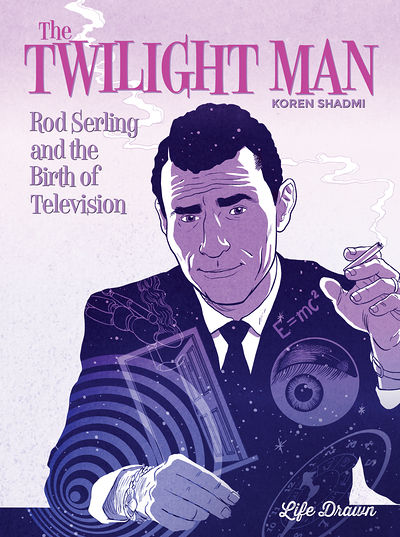
The Twilight Zone: Rod Serling and the Birth of Television by Koren Shadmi

(I know there could be some mistakes in this review. I’m trying to improve my English, thanks)


Lately I've been interested in historical and biographical comics and this is a good example of what I like: a biography of the creator of the cult series Twilight Zone.


Contrary to the first thing that one might think, this is not a story with fantastic overtones, but rather focuses on the purely biographical aspect of Rod Serling, his beginnings long before he was known as the legendary television creator for which he is remembered today: from his hard period as a paratrooper assigned to the Philippines in World War II until his difficult and long escalation on the radio and later in the new medium of television, until he managed to position himself as the media star thanks to this series... even though nothing lasts forever.

I think it is an excellent choice by the author that the drawings are in black and white, as was the television of his time, as well as his austere but also impressive when necessary style. As I have commented before, the script focuses on the purely biographical (in this aspect I understand that it is well documented) and for this reason it does not stop captivating the reader throughout all the reading.